


Blog
News around Smoothline
Collagen from within: what the studies show, and what it means for your skin

Collagen powder is one of the best-selling food supplements and at the same time one of the most contested. Swiss public television summed it up as «a lot of marketing, little evidence», consumer protection bodies advise against it, and yet controlled trials show measurable effects. Who is right? We looked at the evidence as doctors who work with skin every day, and we will tell you what can be substantiated and what cannot.
Why collagen becomes a topic from the age of 25
Collagen is the structural protein that gives skin its firmness. From around the age of 25 the body loses roughly one per cent of it per year. Hyaluronic acid, the skin's moisture molecule, declines markedly from around 40. Neither is a disease, both are physiology. What you see is reduced firmness, finer lines and skin that holds moisture less well.
This is exactly where the idea of supplying collagen from within starts. The only question is whether it works.
The strongest objection: is collagen not simply digested?
This is the most legitimate criticism and it deserves an honest answer. Protein is broken down in the gut. Eating collagen does not direct finished collagen fibres into your skin. Anyone who tells it that way is simplifying to the point of being wrong.
The evidence is more nuanced. Hydrolysed collagen is already pre-digested, and it is not broken down completely into individual amino acids. A proportion reaches the bloodstream as short-chain di- and tripeptides, which has been measured. The working hypothesis is that these peptides act less as building material and more as a signal that prompts the skin's own fibroblasts to produce collagen. In cell and animal models this pathway is well studied. In humans it is inferred indirectly through clinical endpoints rather than measured directly.
In short: the naive mechanism is wrong. The plausible mechanism is a different one, and it is partly substantiated.
What the studies actually show
What several studies agree on
Two systematic reviews with meta-analysis give the best overview. An analysis of 26 randomised controlled trials with 1,721 participants found significant improvements in skin hydration and elasticity for hydrolysed collagen compared with placebo. An earlier analysis of 19 studies with 1,125 participants reached comparable results for hydration, elasticity and wrinkle depth, at an intake duration of around 90 days.
That is more than most nutricosmetic ingredients can show.
Where the limitations are
The author groups point out the weaknesses themselves, and a commentary in the International Journal of Dermatology explicitly criticises the heterogeneity of the included studies: different preparations, different collagen sources, different doses, durations and measurement methods. On top of that, many individual trials are small and manufacturer-funded. The effect sizes are moderate, not dramatic.
Our reading: the available studies are sufficient to call collagen peptides a sensible and valuable supplement. We see an ingestible skincare product as an important add-on, above all to maintain skin quality and to actively counter age-related collagen loss. It does not replace your treatments at Smoothline.
What actually matters in a collagen product
The amount
The clinically studied range is 2.5 to 10 g per day. Many products on the market fall below this or do not state the amount clearly. That is the most common and most expensive mistake at the point of purchase: a product containing the right ingredient at an amount no study has tested.
The form, and why «type I, II or III» says little
Hydrolysed, not native. Collagen tripeptides have particularly short chains and are absorbed particularly efficiently, but they are more expensive and therefore rarely present in meaningful amounts.
When a product advertises «type I», «type II» or «type III», that says little for the skin. Hydrolysis breaks the collagen down into short peptides anyway, and those are essentially the same across sources. The type describes the source tissue, not what ends up in the bloodstream.
The source
Collagen for supplements comes from cattle, pigs or fish, obtained from hide or from bone. For the skin, no species can be identified as superior from the studies, for the same reason as above.
One difference does concern purity: lead accumulates in bone, not in skin. That was measured for bone broth, in a very small study of three chicken broths. For hydrolysed collagen peptides, which are purified and tested batch by batch for heavy metals, no such finding exists. We nonetheless regard hide as the cleaner starting material and use collagen from bovine hide. What matters in the end is that every batch is tested.
The supporting ingredients
Collagen alone is not enough. Vitamin C contributes to normal collagen formation for the normal function of skin, one of the few officially authorised claims in this field. Sulphur, for instance from MSM, is a basic building block of collagen and keratin. Hyaluronic acid addresses the moisture side. Antioxidants such as astaxanthin protect the cells from oxidative stress.
The duration
Trials typically run 8 to 12 weeks. Stopping after three weeks is not a test, it is just money spent. Allow at least three months before you judge.
Collagen and aesthetic treatments are two different levels
These are regularly confused. Fillers replace volume, botulinum toxin reduces muscle activity, biostimulators prompt local collagen formation at the treated site. All three work in a targeted, local way. None of them improves the underlying quality of the skin across the whole surface.
That is where the complementary idea sits. An aesthetic result reads differently on well-supplied skin than on dry, thin skin, and that is a day-to-day observation from practice that anyone comparing before-and-after images can follow.
And here is the honest limit: to date no study has examined whether taking collagen extends the longevity of a filler or measurably improves the treatment result. This is a plausible inference from physiology and not a study finding.
«Longevity X Skincare»: the formula we recommend
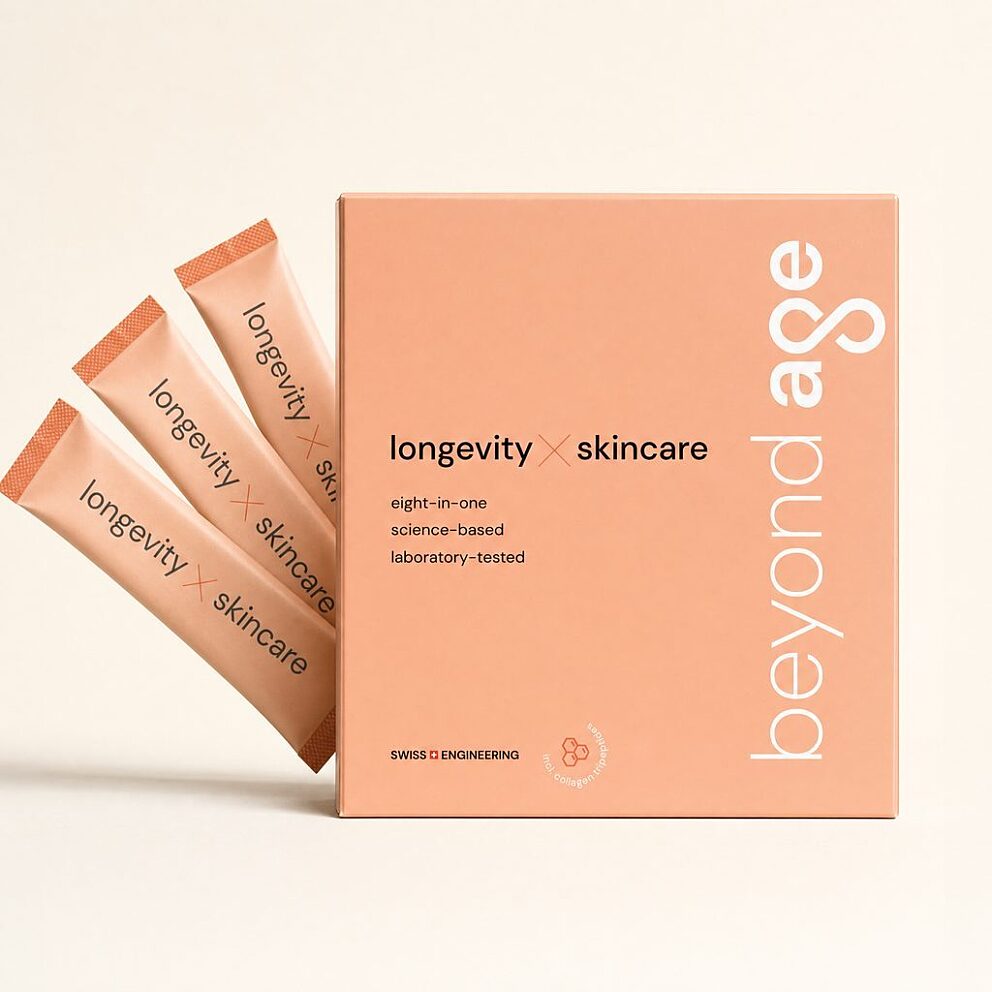
Our medical director Dr Philippe Snozzi developed a formula with his start-up Beyond Age that is built around exactly the criteria above. It was revised in 2026: every ingredient re-examined against current studies and every dose reassessed.
Per daily dose, one sachet dissolved in water:
- 8,000 mg hydrolysed collagen peptides plus 1,000 mg collagen tripeptides, 9,000 mg in total and therefore within the clinically studied range
- 1,000 mg MSM as a sulphur source
- 200 mg hyaluronic acid
- 25 mg nicotinamide, which contributes to the maintenance of normal skin
- 4 mg astaxanthin
- 50 mg vitamin C from acerola extract, which contributes to normal collagen formation for the normal function of skin and protects cells from oxidative stress
- 125 mg turmeric extract with 2 mg Piper nigrum extract, which markedly improves absorption of the curcumin
28 sachets for four weeks, blood orange flavour, CHF 89.–. Developed and scientifically overseen in Switzerland, manufactured in a GMP and ISO 22000 certified facility, with a quality certificate for every batch.
Frequently asked questions
How long before anything shows?
Observation periods in the trials run 8 to 12 weeks, in some cases 90 days. No judgement is possible before two to three months have passed.
Is collagen from bovine, marine or porcine sources better?
The meta-analyses could not identify any source as clearly superior. The degree of hydrolysis, the daily amount and the supporting ingredients matter more.
Can I combine collagen with fillers or botulinum toxin?
Yes. There is no known interaction. The two approaches work on different levels and do not exclude each other.
Are there side effects?
Collagen peptides are considered well tolerated. Mild gastrointestinal complaints are occasionally reported. Caution applies with known allergies to the raw material source.
Who should not take it?
Not suitable during pregnancy and breastfeeding or for children and adolescents under 18. With existing conditions, in particular of the liver, kidneys, heart or immune system, with active or previous cancer, and when taking medication regularly, seek medical advice before use.
Does collagen replace a treatment?
No. It complements one. A food supplement moves no volume and relaxes no muscle.
Our conclusion
Collagen taken by mouth is well studied. For skin hydration and skin elasticity, several studies have repeatedly shown positive results. The effects are measurable, if not dramatic, and the studies differ in design and quality.
For you that means: taking a product in a sufficient amount, in hydrolysed form and with sensible supporting ingredients over at least three months is a sensible thing to do for your skin. We see it as an important add-on for maintaining skin quality and actively countering age-related collagen loss. It does the most alongside your treatments at Smoothline, not in place of them.
If you would like to know whether this makes sense in your situation, talk to us. Our doctors are happy to advise you, independently of any treatment.
Order «Longevity X Skincare»: beyondage.life. Smoothline clients receive 10% off with the code SMOOTHLINE10.
Sources:
Pu S-Y et al. Effects of Oral Collagen for Skin Anti-Aging: A Systematic Review and Meta-Analysis. Nutrients 2023;15(9):2080. doi.org/10.3390/nu15092080
de Miranda RB, Weimer P, Rossi RC. Effects of hydrolyzed collagen supplementation on skin aging: a systematic review and meta-analysis. Int J Dermatol 2021;60(12):1449-1461. doi.org/10.1111/ijd.15518
Peres G et al. Concerning the heterogeneity of the studies included in meta-analyses. Comment on: «Effects of hydrolyzed collagen supplementation on skin aging». Int J Dermatol 2021;61(3):e99-e101. doi.org/10.1111/ijd.15748
Dewi DAR et al. Exploring the Impact of Hydrolyzed Collagen Oral Supplementation on Skin Rejuvenation: A Systematic Review and Meta-Analysis. Cureus 2023;15(12):e50231. doi.org/10.7759/cureus.50231
Ingredient and dosage data: Beyond Age AG product documentation, pack status 21 April 2026. Authorised health claims per EFSA and the Swiss Information Ordinance (LIV).
Sources last verified via PubMed on 12 September 2026.